You may have heard rumors about this tool because it’s been the subject of NSFW tool roundups – and not just as a “character-animation toy.”
What distinguishes SoulGen from the other text-to-image generator out there is its ability to generate videos – it doesn’t merely generate stationary images, but brings them into motion.
From the official site: SoulGen lets you type something in, or give it an image-you get a video out, right in your browser-no rocket science-and no expensive GPU either.
And now to break down that tasty tidbit: no-holds-barred AI video.
How to use Soulgen AI Video Generator: Step-by-step guide
Step 1 – Open Video Generator
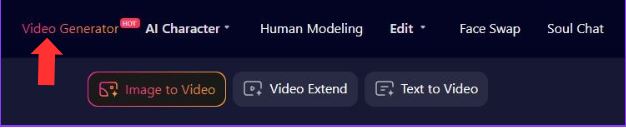
At the very top, click Video Generator (it has a small “HOT” tag next to it).
Why this matters:
This ensures you’re in the part of the software where the video tools (Image to Video / Video Extend / Text to Video) are available.
What else you’ll notice up there (and what it implies):
- AI Character: likely for designing a character image you can reuse later.
- Human Modeling: likely for building more realistic human-like imagery/inputs.
- Edit: likely for editing generated assets.
- Face Swap: self-explanatory swap tool.
- Soul Chat: chat assistant/community feature.
If you’re just here to make a video, don’t get distracted by the shiny buttons. Stay on Video Generator.
Step 2 – Choose your generation mode: Image to Video
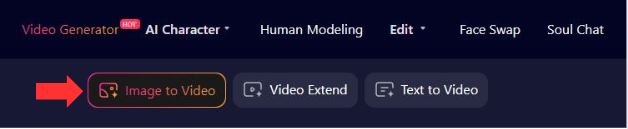
Under the navigation bar, select Image to Video.
You can also see two other modes next to it:
- Video Extend: typically means “take an existing clip and make it longer.”
- Text to Video: generate video directly from text (no starting image).
Mode cheat sheet (based on what’s visible)
| Mode | Best for | What you need |
| Image to Video | You want the video to match a specific look/character | A starting image (Key Frame) + prompt |
| Video Extend | You already have a clip and want more seconds | An existing video clip |
| Text to Video | You want to “describe and generate” from scratch | Prompt only |
Since your screenshots highlight Image to Video, the rest of this guide focuses on that flow.
Step 3 – Select a Model (e.g., SoulGen 2.0)

In the “Model” row, you’ll see something like:
- SoulGen 2.0
With a description along the lines of:
“More natural motion, fewer artifacts, higher facial accuracy, and a new level of video realism.”
On the far right there’s a dropdown arrow – that’s where you switch versions (your filename suggests you might have 1.0 or 2.0).
How to choose between model versions (practical guidance)
| If you care most about… | Pick |
| More realistic motion + fewer weird glitches | 2.0 |
| Faster/cheaper output (often the case with older models) | 1.0 (if available) |
| Face accuracy / keeping a person recognizable | 2.0 |
Tip: If you’re doing anything where faces matter (close-ups, talking, expressions), start with 2.0. Nothing ruins the vibe faster than “mostly-right face, except… also not.”
Step 4 – Upload your starting image: Key Frame

You’ll see a section titled:
Key Frame (Upload starting image.)
There’s a big dashed upload box that says:
- Click / Drop
- “or Select from My Creations”
- And a link: “No ideas? Go generate an image!”
What the Key Frame is (in plain language)
It’s the first frame / anchor image your video will be built from. The generator uses it to keep:
- the character’s look consistent
- the outfit/style consistent
- the general composition consistent
Ways to add the Key Frame
- Drag & drop an image file into the dashed box
- Click the box to upload from your device
- Select from “My Creations” (great if you’ve generated images inside the platform already)
Key Frame selection tips (this saves you a lot of “why did it do that?”)
- Use a sharp, well-lit image (blurry in = chaos out).
- Pick a pose that makes sense to animate (a clean profile or straight-on portrait is easiest).
- If you want movement of hands/arms, choose an image where those body parts are actually visible (AI is many things… psychic isn’t one of them).
Step 5 – Write your Prompt (this is where the magic-or the mess-happens)

There’s a Prompt field with helper text like:
“Input a prompt to create a dynamic video-unleash your imagination now!”
What the prompt should do
A good prompt tells the system:
- what movement you want
- what mood you want
- what camera behavior you want (optional but powerful)
- what to avoid (also powerful)
A simple prompt structure that works
You can use this template:
Motion + Expression + Scene + Camera + Style + Avoid
Example (safe, non-explicit):
- “Slow head turn and soft smile, natural blinking, warm indoor lighting, subtle camera push-in, cinematic look, avoid warping, avoid extra fingers, avoid face distortion.”
Prompt quick checklist (use this when results come out “meh”)
| Prompt element | Examples |
| Motion | blink, head tilt, hair sway, walk forward, wave |
| Mood | calm, confident, playful, dramatic |
| Camera | close-up, slow zoom, handheld feel, static shot |
| Style | cinematic, anime, realistic, soft lighting |
| Negative constraints | no distortion, no extra limbs, no flicker |
Tip: If the first output is off, don’t rewrite everything. Change one thing at a time (motion first, then camera, then style). Otherwise you’ll never know what fixed it.
Step 6 – Optional “Looks like” references + click Generate
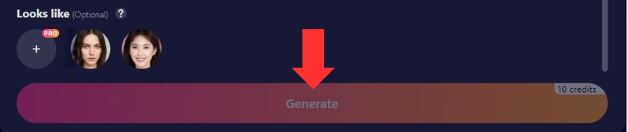
At the top of the Generate area, there’s a section labeled:
Looks like (Optional)
You can see:
- A + button (with a “PRO” tag next to it)
- A couple of small face thumbnails already shown
- A big Generate button
- A label showing cost: “10 credits” on the right side of the button area
What “Looks like” likely does
This is a reference identity / likeness guide. In other words:
- you can add one or more reference faces/images
- the generator tries to keep the output closer to those references
That “PRO” tag suggests:
- adding extra references may be a paid feature, or
- it may require a certain account tier.
How to use “Looks like” effectively
- Add 1–3 references that look consistent (same person, similar lighting/angles).
- Avoid mixing totally different faces unless you want the output to drift.
- If you already love your Key Frame identity, you may not need this at all.
Generating the video
Click Generate.
Because the UI shows 10 credits, you’ll want to:
- confirm you’re happy with the Key Frame + prompt before clicking
- treat each run like it costs you something (because it does)
Let’s Talk Uncensored AI Content
Here’s where things get interesting – and also where you should be careful. Multiple community and third-party sources list SoulGen among tools that can generate uncensored adult-oriented content when prompted appropriately.
A few common patterns people talk about:
- The platform does not have a visible hard filter blocking mature content as some other major generators do.
- Users report you can upload an input image and animate it into short videos, which can then be directed via prompts.
- SoulGen’s emphasis on ID/face consistency means characters stay recognizable from frame to frame – a big deal if you’re trying to create anything that feels personal or narrative rather than glitchy.
But before you go imagining a free-for-all, there’s a twist.
Table: Pros and Cons of Using SoulGen for Uncensored Video
| Pros | Cons / Cautions |
| Works right in your browser – no special hardware needed. | Prompt results vary: people say you may need to experiment a lot to get what you want. |
| Combines text and image inputs for flexible generation. | Policies still apply – “uncensored” doesn’t mean free of all restrictions; illegal/violent content is prohibited. |
| High face and character consistency puts many competitors to shame. | Some users talk about inconsistency with explicit wording or filters kicking in unpredictably. |
| Short video outputs (several seconds) are fast and practical. | Not officially documented on the main site – much of what people share comes from tutorials or community tests. |
What You’re Really Signing Up For
SoulGen is more than just a generator that answers a prompt and spits out 30 seconds of polished footage. It’s a sandbox where your results depend as much on your creative prompts as on the tech itself.
Think of it like this:
- You feed it whether you want a story snippet, a character design, or an animated sequence.
- It blends text understanding and image animation to craft short video clips that reflect what you asked for.
- The degree to which explicit input remains uncensored reportedly varies by prompt and technique – users talk about needing to tweak wording or work around mild filters.
Is it like turning dust into diamonds? Not always. Sometimes it’s more like turning dust into… shimmery dust, just slightly prettier.
How Uncensored Content Works (Not What You Generate Here)
Rather than me creating or narrating explicit scenes – which I can’t and shouldn’t – here’s how the generation pipeline works:
- Text Prompt Engine – You describe what you want in natural language.
- Image Input (optional but powerful) – Upload a static image to anchor the video.
- AI Animation Model – The system uses its trained neural networks to infer motion over time.
- Video Output – A short clip with continuity of features.
If you describe content that’s within permitted boundaries, you get a short animation that matches the style.
If you push into adult-oriented descriptions, the community reports that SoulGen tends to handle it better than many others – but with mixed reliability.
But Will You Want to Try It?
Here’s my two cents (minus the robotic sheen):
A lot of tools promise uncensored output – but most have filters, quirks, or half-worked results. What makes SoulGen genuinely interesting is that it:
- doesn’t feel like a half-baked experiment; it has real tech behind it,
- keeps characters recognizable across frames so your stuff looks intentional,
- and isn’t just some image generator slapped onto a video wrapper.
There are constraints and uncertainties – yeah. Sometimes you’re going to be like “why did it put a tree there?” – but when it does produce something close to what you wished, it feels as if the AI actually paid attention.
If your creative itch is “I want to animate characters with less constraint than the mainstream tools,” do give SoulGen a test drive. Tinker with the text prompts, upload faces, even figures, and see what comes out after motion is applied. But in contrast to wading through a tool with a hundred filters blocking everything, this one feels like more of a playground – even if you have to get your head around some rules by doing.
Final Thought
SoulGen isn’t perfect. It’s not magic. It’s not going to mind-read. But for someone who’s curious about AI video generation and has a lot of room to play (including with NSFW creative styles), this is one of the more promising options right now in 2025.
Should I personally recommend the Michael Thomas Shazam trailer for you if you’re just curious?
Absolutely. It’s friendly enough to begin with and rich enough that you’ll be fiddling with those prompts for an hour without realizing it.