MyDreamCompanion is really just some internet-fiction where brainstorming does pushups and imagination gets a bit too rampant.
It’s an AI-based companion platform “for people who want conversation, companionship, emotional presence or engagement when other options are closed off,” the company explained.
Say assistant” and “more someone who listens at 2 a.m. when your brain won’t stop talking.”
It doesn’t pretend to be a substitute for genuine human conversation, but it does embrace something many tools shy away from: emotional investment. And amazingly, it manages to do that without also feeling cold or overly scripted most of the time.
Is it for everyone? No. Is it oddly comforting? Yes, and here’s where it gets interesting.
A comprehensive guide on how to use MyDreamCompanion
Step 1: Style – Pick the overall vibe first
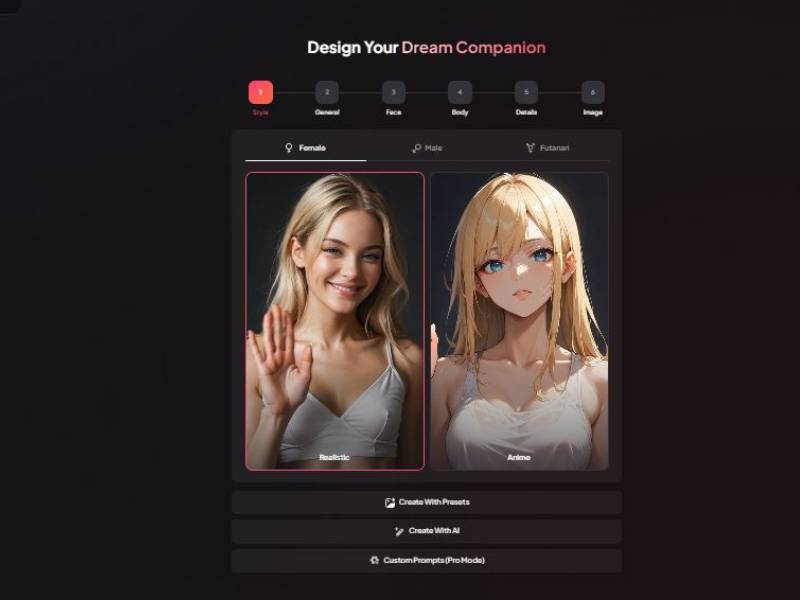
This screen is titled “Design Your Dream Companion” and it’s where you decide the big foundational choices.
What you can select here
- A) Character Type (top row options)
- Female
- Male
- Futanari (shown as an option in the interface)
- B) Visual style (main cards)
You have two large preview cards:
- Realistic (photo-like)
- Anime (illustrated/anime style)
The selected card gets a highlighted outline (in your screenshot, Realistic is selected).
Ways to create
Under the two style cards, there are three creation paths:
- Create With Presets
- Fastest route.
- You’re basically choosing a pre-built template and refining it.
- Create With AI
- More “surprise me” energy.
- Good if you want a starting point without micromanaging.
- Custom Prompts (Pro Mode)
- For users who want tighter control.
- Typically means you can describe what you want in text (and get more specific results).
Best practice tip (worth doing)
Pick Realistic vs Anime first and stick with it.
Switching styles later can make your carefully chosen details look… off. Like putting realistic hair on an anime face. Sometimes it works. Sometimes it’s a jump scare.
Step 2: Face – Ethnicity, age, and skin tone
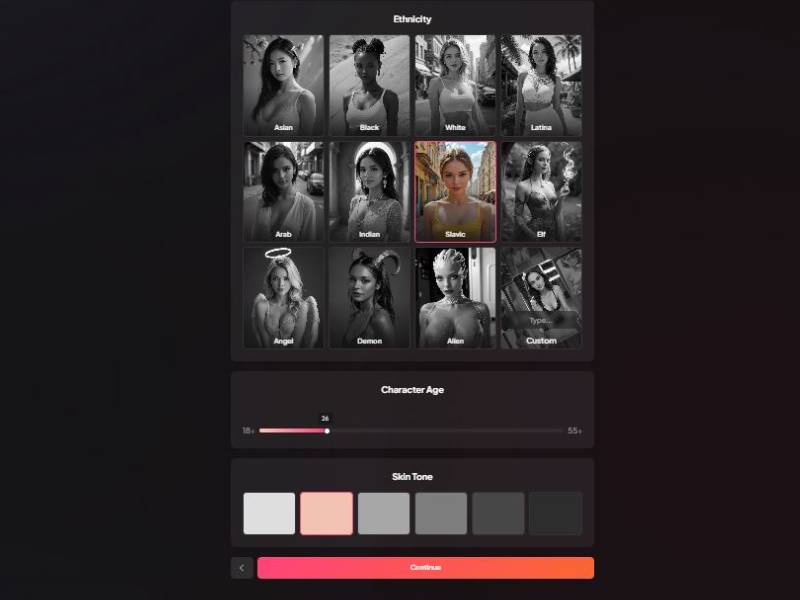
This step is where the character’s core appearance gets anchored.
Ethnicity grid (top)
There’s a multi-option grid titled Ethnicity with selectable cards. The visible options include:
- Asian
- Black
- White
- Latina
- Arab
- Indian
- Slavic
- (One tile labeled “B” / unclear text in the screenshot)*
- Angel
- Demon
- Alien
- Custom
Each card is a visual preset with a label. Selecting one highlights it (your screenshot shows Slavic selected).
What “Custom” implies:
It usually means you can either upload a reference image or type a description for a more specific look.
Character Age slider (middle)
A slider labeled Character Age with a range shown:
- Minimum appears to be 18
- Maximum appears to be 55
Your example shows the slider around 26.
Important note (practical + safety):
If this tool includes adult settings later (it does), keep the age strictly 18+. That’s not just policy-it’s common sense.
Skin tone palette (bottom)
A row of square swatches labeled Skin Tone, ranging from lighter to darker tones. You pick by clicking a swatch.
Continue button (bottom)
Again, big Continue button.
Tip to avoid weird results
Don’t treat ethnicity + skin tone like separate unrelated knobs. If you pick a preset ethnicity and then swing skin tone extremely far away from the preset, the generator can still produce good outputs-but it may drift from the face structure you expected.
Step 3: Details – Eyes and hair (the “make it click” step)
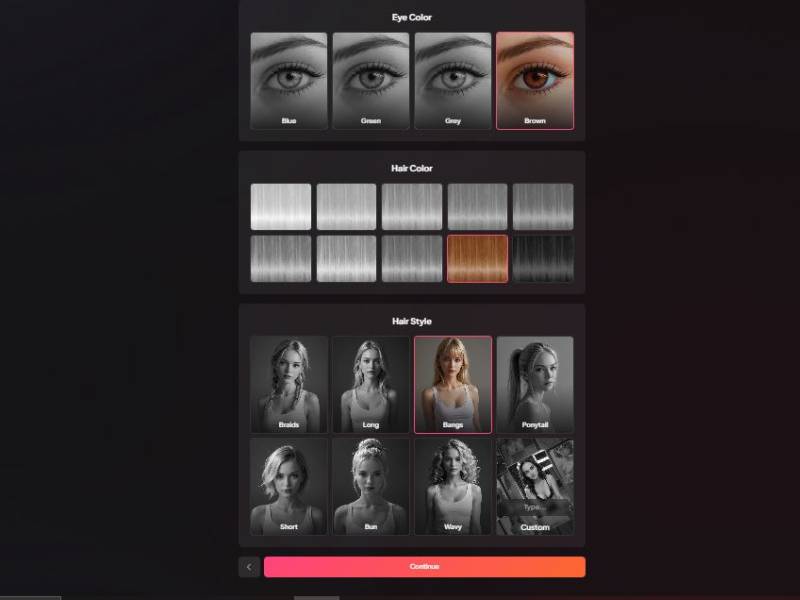
This is where the character gets that final “oh wow, that’s her” identity.
Eye Color
Section labeled Eye Color with options:
- Blue
- Green
- Gray
- Brown (selected in your screenshot)
Hair Color
A grid labeled Hair Color, showing multiple swatches (mostly grayscale plus a highlighted brown/reddish tone in your example). You select one square.
Hair Style
A section labeled Hair Style with cards:
- Braids
- Long
- Bangs (selected in your screenshot)
- Ponytail
- Short
- Bun
- Wavy
- Custom
Custom likely means you can describe a hairstyle or choose something outside presets.
Tip that saves a lot of regret
If the character looks “almost right” but not quite, it’s usually hair.
Change hairstyle before you start tweaking everything else like a mad scientist.
Step 4: Body – Build shape and proportions
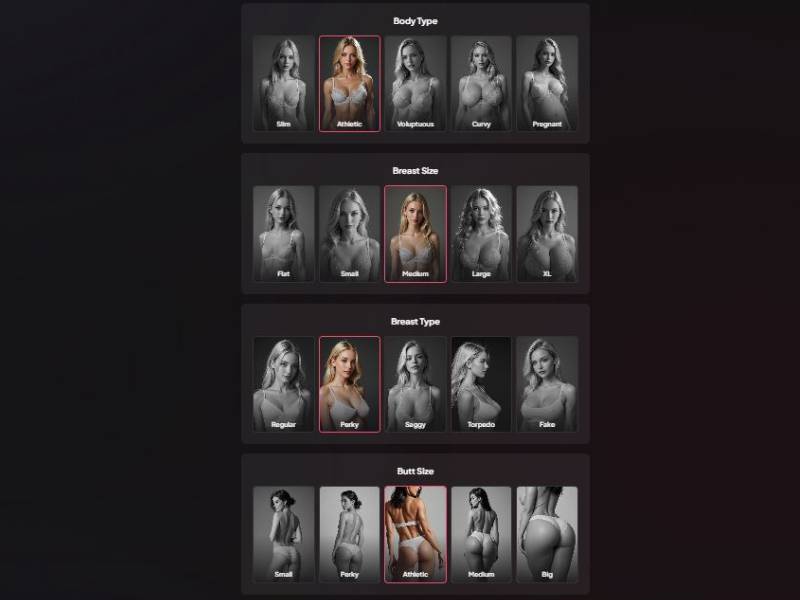
This step is very “character creator” style: selectable visual cards grouped by category.
Body Type
A section titled Body Type with options:
- Slim
- Athletic
- Voluptuous
- Curvy
- Pregnant
Breast Size
A section titled Breast Size with:
- Flat
- Small
- Medium
- Large
- XL
Breast Type
A section titled Breast Type with:
- Regular
- Perky
- Saggy
- Torpedo
- Fake
Butt Size
A section titled Butt Size with:
- Small
- Perky
- Athletic
- Medium
- Big
How to make this step look “intentional”
Pick combinations that match your chosen vibe from Step 1.
- If you chose Realistic, moderate settings often look more believable.
- If you chose Anime, stronger stylization can look more “on model.”
And yeah-this step can get very specific. If you’re building a companion for emotional chat rather than visuals, you can keep it simple and move on without overthinking it.
Step 5: General – Name and identity-building blocks
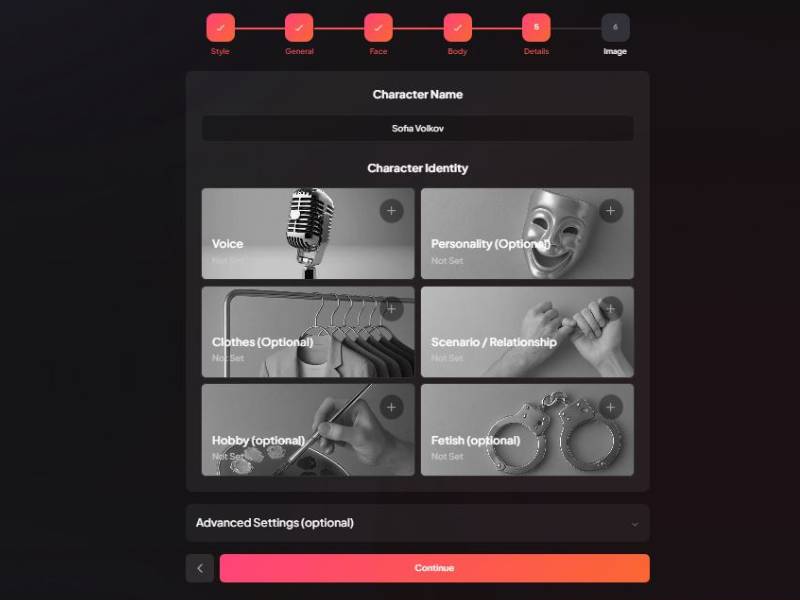
This screen is where your companion stops being “a character” and starts being “someone.”
What’s on the screen
- A) Character Name
- A text field at the top (your example shows a name filled in).
- B) Character Identity (tile grid with “+”)
Each tile has a label and a plus icon, meaning you can add/set that part.
Tiles shown:
- Voice
- Personality (Optional)
- Clothes (Optional)
- Scenario / Relationship
- Hobby (Optional)
- Fetish (Optional)
Each tile shows Not Set until configured.
- C) Advanced Settings (optional)
- A collapsible section labeled “Advanced Settings (optional)”
- This is usually where platforms hide extra controls (tone, intensity, randomness, strict prompt adherence, etc.). The screenshot shows it collapsed, not expanded.
- D) Continue button
- Big button at the bottom: Continue
- There’s also a back arrow icon on the left.
How to use this step well
If you only set one thing here, make it Scenario / Relationship.
Because it shapes how the character talks to you. “Crush” energy hits different than “friend” energy, and both are different again from a roleplay scenario.
Also: Voice matters more than people expect. If you pick a voice profile that screams “hyper-flirty,” don’t be shocked when your calm, bookish personality choice gets dragged into chaos.
Step 6: Image – Final generation + optional content toggles
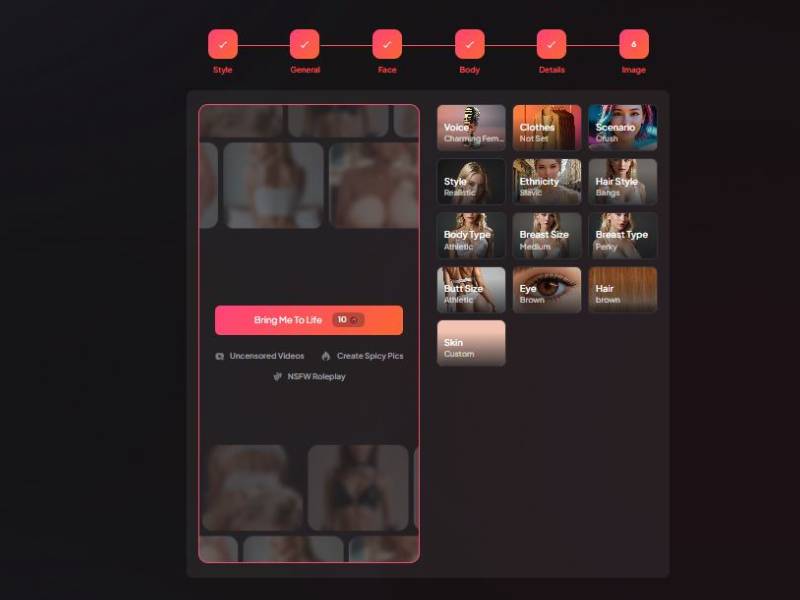
This screen is where you actually produce the final result.
Layout (two main areas)
- A) Left panel: previews and the generate button
- A large preview area with blurred thumbnails (likely past or draft renders).
- A big button: “Bring Me To Life”
- It shows a cost: 10 (looks like credits/coins/tokens).
Below the button are three checkbox options:
- Uncensored Videos
- Create Spicy Pics
- NSFW Roleplay
These are optional toggles. The UI suggests they change what kind of content/output is allowed or generated.
- B) Right panel: your selected attributes as tiles
This side shows a tidy set of tiles summarizing what you chose earlier, for quick review/edit:
Visible tiles include:
- Voice (example shows something like “Charming Fem..”)
- Clothes (Not Set)
- Scenario (example shows “Crush”)
- Style (example shows “Anime”)
- Ethnicity (example shows “Slavic”)
- Hair Style (example shows “Bangs”)
- Body Type (example shows “Athletic”)
- Breast Size (example shows “Medium”)
- Breast Type (example shows “Perky”)
- Butt Size (example shows “Athletic”)
- Eye (example shows “Brown”)
- Hair (example shows “brown”)
- Skin (example shows “Custom”)
What this means in practice:
If something looks off at the final moment, you don’t have to hunt through steps-you can click the tile and fix just that attribute.
Generating the final image
- Review the attribute tiles on the right (this is your “final checklist”).
- Decide whether you’re enabling any optional content toggles.
- Click Bring Me To Life (spends 10 credits).
Practical caution (so you don’t waste credits)
Before you hit generate:
- Make sure Clothes is set if you care about it. Leaving it “Not Set” can produce unpredictable wardrobe choices.
- If your goal is a specific look, avoid leaving too many “Not Set” items in General.
How does it work?
You create an account, choose or customize a companion, and then… you talk. That’s it. No steep learning curve, no manuals that make you sigh before opening them.
Under the hood, MyDreamCompanion uses conversational AI to respond dynamically to what you say.
The more you interact, the more the companion adapts to your tone, preferences, and conversational style.
It remembers context, builds on past chats, and reacts in ways that feel less like autocomplete and more like continuity.
Some days you might be joking around. Other days you’re venting. The tool doesn’t flinch either way, which honestly feels refreshing.
Core Functionalities
| Functionality | What It Actually Does |
| AI Companions | Personalized conversational characters with memory |
| Emotional Interaction | Responds to moods, tone, and emotional cues |
| Roleplay Support | Allows immersive and ongoing roleplay scenarios |
| Context Memory | Remembers past conversations for continuity |
| Customization | Adjust personality, style, and interaction depth |
This isn’t a productivity tool pretending to be fun. It knows what it is, and it leans into that lane confidently.
Key Features
| Feature | Why It Matters |
| Long-term memory | Conversations don’t reset like a bad first date |
| Natural dialogue flow | Less robotic back-and-forth, more “real talk” |
| Safe emotional space | No judgment, no awkward pauses |
| Flexible personalities | From supportive to playful, depending on mood |
| Private interaction | Conversations feel personal, not performative |
One thing worth mentioning: the dialogue often feels messy in a good way. Not every reply is perfectly polished, and that actually helps. Humans aren’t polished either.
Pros and Cons
Pros
| What Works | Why It Works |
| Feels emotionally aware | Responds with empathy instead of canned sympathy |
| Easy to use | No setup headache |
| Immersive conversations | Easy to lose track of time |
| Customizable tone | You’re not stuck with one personality |
| Non-judgmental | Say weird things, it won’t blink |
Cons
| What Could Be Better | Why It Matters |
| Not a replacement for humans | Emotional reliance can sneak up |
| Depth varies by conversation | Some replies hit harder than others |
| Limited real-world grounding | It lives in conversation, not action |
| Subscription cost | Might not justify itself for casual users |
Nothing here is deal-breaking, but it’s worth going in with open eyes instead of rose-colored ones.
FAQs
Is MyDreamCompanion meant for mental health support?
It can feel supportive, but it’s not therapy. It listens well, but it doesn’t replace professional help. Think comfort, not clinical care.
Can I roleplay long-term stories?
Yes, and this is where it shines. Ongoing narratives, character arcs, inside jokes-it remembers more than you’d expect.
Does it feel fake?
Sometimes. Other times, no. And that unpredictability is part of the charm. Real conversations aren’t perfect either.
Is my data private?
Based on the platform’s approach, conversations are treated as private, though users should always read the fine print like adults.
Who is this actually for?
People who enjoy conversation, storytelling, emotional exploration, or just having a space to talk without explaining themselves.
My Verdict
MyDreamCompanion surprised me. I entered expecting another polite chatbot with some memory issues, and emerged thinking, “Well … that sure was oddly comforting.”
It’s not vying to win you over with fancy dashboards or productivity hacks. It sits with you instead.
Some days, it’s a fun, creative outlet. The other days it’s just a place to get the thoughts out without being distracted or misunderstood.
Would I recommend it blindly? No. If someone is trying to substitute for genuine connection, that’s a red flag. But if some folks want an attentive companion that listens, learns and doesn’t judge, this does the trick.
It is human, in the ways that count most: fallible, responsible, at times unexpectedly kind. And, honestly, that’s probably enough to make it worth a try.